



Cayman company registration is the core first choice for multinational enterprises, cross-border e-commerce businesses, investment institutions, and companies planning to list on U.S. or Hong Kong stock markets (IPO) to achieve overseas asset allocation, reasonable tax planning, and the establishment of VIE structures. As a globally renowned offshore financial center, the Cayman Islands, with its highly confidential legal system and well-established financial support services, has become the most valuable “entry ticket” in the offshore business landscape.
I. Why Choose Cayman Company Registration? Four Core Advantages
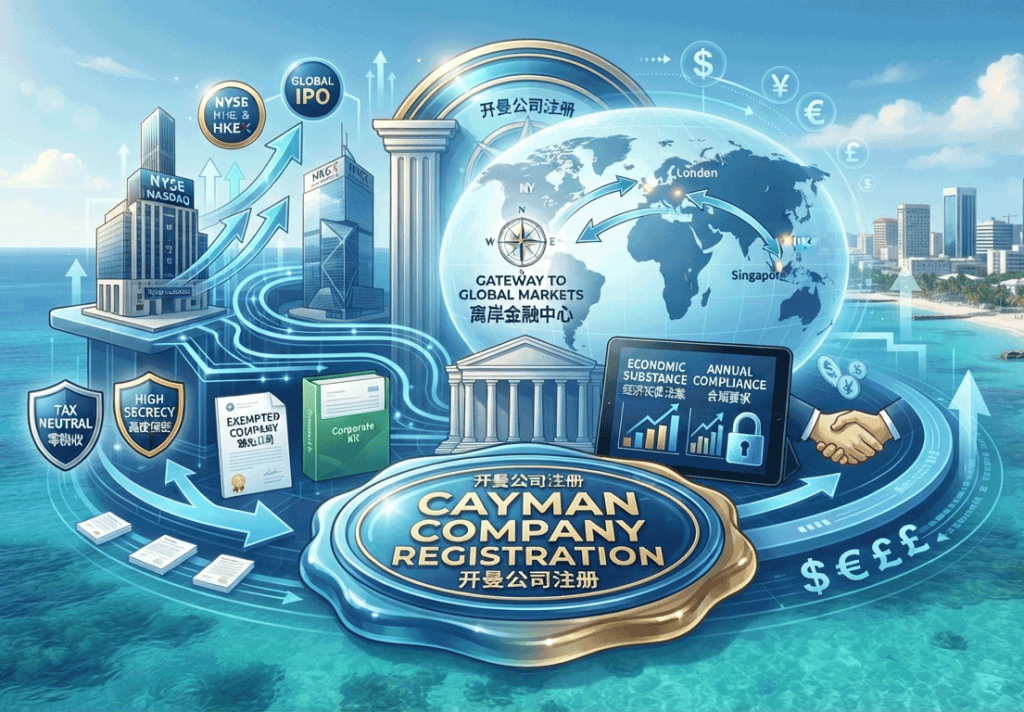
1. Facilitating Overseas Listing (IPO): The Cayman Islands is an offshore jurisdiction fully recognized by the Hong Kong Stock Exchange (HKEX), the New York Stock Exchange (NYSE), and NASDAQ. Its mature VIE structure (variable interest entity) is widely adopted by the vast majority of China-concept stock companies.
2. Tax Exemption and Tax Planning: The Cayman Islands has no corporate income tax, no capital gains tax, no withholding tax, and no inheritance or gift tax. As long as the company does not conduct substantive operations locally in Cayman, it can enjoy the zero-tax policy of an Exempted Company.
3. High Confidentiality of Shareholder Information: Sensitive information such as directors, shareholder registers, and registered capital of Cayman companies is not publicly disclosed, and the public cannot directly access it, providing a very high level of commercial privacy protection.
4. Zero Capital and Foreign Exchange Controls: Funds can flow freely in and out without foreign exchange controls, making it convenient for enterprises to allocate funds in international markets, conduct cross-border mergers and acquisitions, and open global multi-currency offshore accounts.
II. Core Types of Cayman Company Registration
When registering a company in the Cayman Islands, the most commonly used type is the Exempted Company.
1. Business Restrictions: It cannot conduct commercial activities with the public within the Cayman Islands.
2. Name Selection: The company name does not have to end with “Limited” or “Ltd,” offering extremely high naming flexibility.
3. Tax Guarantee: A “tax exemption guarantee” valid for 20-30 years can be obtained from the Cayman government.
4. Annual Review Requirements: Only an annual return needs to be submitted each year along with the payment of franchise tax; no detailed financial audit report is required.
III. What Materials Are Needed to Prepare for Cayman Company Registration?
Before proceeding with Cayman company registration, applicants need to prepare the following basic compliance materials:
1. Company Name: Prepare 2-3 English names (a Chinese name may be added); the name must not duplicate an already registered company.
2. Shareholders and Directors: At least one shareholder and one director are required (the same person may hold both roles), with no restrictions on nationality or legal residency.
3. Identity Proof: Valid passport copies and ID card copies of all shareholders and directors.
4. Address Proof: Provide utility bills, bank statements, or driver's licenses from the past 3 months as proof of the individual's usual residential address.
5. Legal Secretary and Registered Address: A registered address and legal secretary provided by a licensed trust company must be maintained locally in the Cayman Islands (usually provided uniformly by the agency).
IV. Standard Cayman Company Registration Process
The standard processing period for Cayman company registration is usually 15-20 working days. The specific steps are as follows:
1. Name Approval: Submit the proposed company name to the Cayman Islands Companies Registry for search and name verification.
2. Document Signing: Determine the registered capital (the standard registered capital is USD 50,000, with no actual capital contribution or capital verification required), and sign the Memorandum and Articles of Association (M&A) and statutory registration documents.
3. Government Approval: Submit the fully signed statutory documents to the Cayman Companies Registry, where the government reviews them and issues the business license.
4. Preparation of the Green Box: Includes the company's articles of association, company seal, share certificate book, register of directors and shareholders, and a full set of other statutory documents.
5. Bank Account Opening: Using the full set of registration documents, accountant's certified true copy (CTC), etc., apply to open an offshore bank account in Hong Kong, Singapore, or the United States.
V. Cayman Islands Economic Substance Law (Economic Substance)
Since the implementation of the Economic Substance Act, companies registered in Cayman that are involved in “relevant activities” (such as holding company business, headquarters business, fund management, shipping, banking, insurance, intellectual property, etc.) are required to meet the corresponding economic substance requirements (ESR).
1. Pure Holding Companies: Pure holding companies that only hold equity in other entities only need to meet the “reduced substance requirements,” that is, submit the annual return in Cayman on time and maintain a local registered address and secretary.
2. Non-Pure Holding Companies: Entities involved in other core businesses such as trading, services, or intellectual property must demonstrate substantive business operations in the Cayman Islands (such as holding board meetings, having local employees or office premises), or reasonably plan their tax residency status.
VI. Frequently Asked Questions (FAQ)
Q1: Are the annual maintenance costs high after Cayman company registration?
A1: Cayman companies need to file an Annual Return each year, pay franchise tax (license fee) to the Cayman government, and also pay maintenance fees for the local registered address and secretary. If the annual review is overdue, substantial penalties will be incurred and the company may even be forcibly deregistered.
Q2: Do I need to go to the Cayman Islands in person to register a Cayman company?
A2: No. The entire registration process can be completed remotely online through a professional offshore agency, and all identity materials and signed documents can be transferred digitally or by mail.