


How can enterprises build a compliant and efficient international corporate structure when going global? This article provides an in-depth breakdown of the classic cross-border structure system of “Cayman parent company + BVI holding company + Hong Kong operating company,” offering a detailed analysis of the respective positioning, core advantages, and applicable scenarios of Cayman, BVI, and Hong Kong companies, helping global brands, cross-border e-commerce businesses, and technology enterprises avoid pitfalls in structuring and steadily advance toward international capital markets.
In the procedures for enterprises expanding globally, raising funds overseas, or planning overseas listings (such as on U.S. or Hong Kong stock markets), “Cayman + BVI + Hong Kong” is one of the most commonly referenced classic structures.
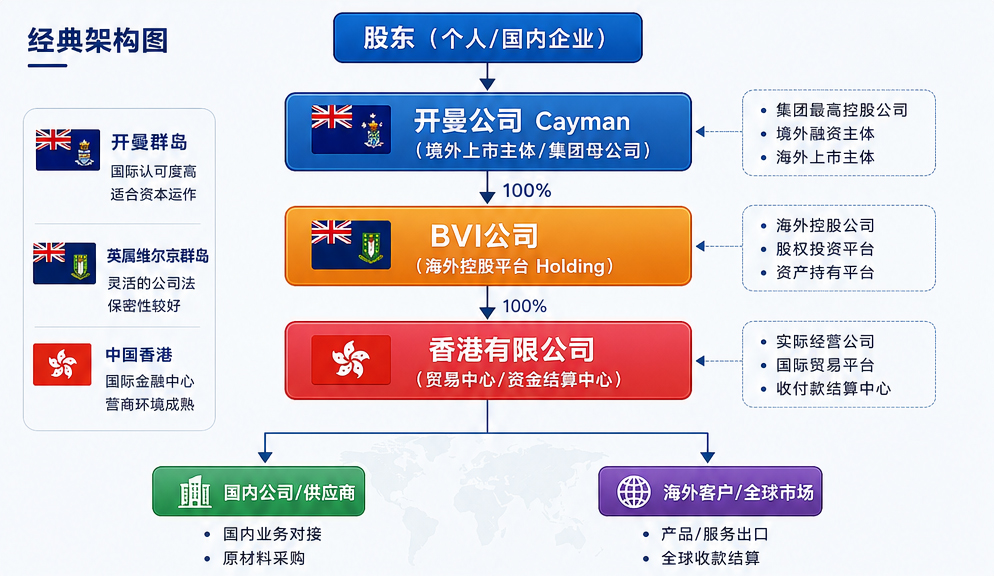
Cayman sits at the top level for financing and listing, BVI sits in the middle for equity isolation and flexible transactions, and Hong Kong sits at the bottom for actual business operations and global receipts and payments.
I. What Is the Function of the Three-Tier Cayman + BVI + Hong Kong Corporate Structure?
1. Top Tier: Why Is Cayman the Preferred Choice for the Top-Level Parent Company?
In most cross-border structures or red-chip structures, a Cayman Islands company is usually placed at the very top as the group parent company and overseas listing entity.
① High recognition in international capital markets: Mainstream exchanges such as HKEX, the Stock Exchange of Hong Kong, NASDAQ, and NYSE all highly recognize Cayman companies as listing entities.
② Extremely convenient financing and secondary offerings: The equity structure design is flexible, making it convenient to introduce international venture capital (VC) and private equity (PE) funds such as Sequoia and Hillhouse.
③ Extremely high public awareness and compliance: Compared with other offshore jurisdictions, Cayman has extremely high recognition in international financial markets and is suitable for long-term capital operations.
2. Middle Tier: What Role Do BVI Companies Play in Overseas Holding Structures?
Many startups wonder: since Cayman and Hong Kong are already in place, why add an additional layer of BVI company (British Virgin Islands) in the middle?
① Risk and asset isolation: BVI serves as a “firewall” between the top-level Cayman parent company and the bottom-level Hong Kong operating company. If debt disputes arise in the underlying business, the risk can be isolated at the BVI level and will not directly affect the Cayman parent company.
② Extremely convenient equity transfer: When the group needs to sell or transfer a certain overseas asset/subsidiary, it can simply transfer the equity of the BVI company, with simple procedures, strong confidentiality, and high efficiency.
③ Organizing multiple business lines: If the group has multiple subsidiary business segments (such as cross-border e-commerce, overseas SaaS, and supply chain), different BVI companies can be established separately for classified holding.
3. Operating Tier: Why Must Business Implementation and Fund Settlement Choose a Hong Kong Company?
Although offshore companies (such as Cayman and BVI) are suitable for equity control, because they do not have substantive operating attributes, they usually find it difficult to open regular commercial bank accounts for large-scale daily receipts and payments. At this point, a Hong Kong company assumes the important task of “on-the-ground operations”:
① Global receipts and payments and fund settlement: Hong Kong has a world-class financial system, with no foreign exchange controls on capital inflows and outflows, making it convenient to connect with global clients and open bank accounts (subject to bank compliance review).
② Trade and contracting entity: Hong Kong's legal system is mature (common law system), and when signing international trade contracts with overseas customers and suppliers, contractual enforceability and recognition are extremely high.
③ Reaching Asia-Pacific and Mainland China: Hong Kong has unique geographical and policy advantages and is the best bridge connecting the Chinese mainland market with overseas markets.
II. Functional Division of the Three Companies: Cayman, BVI, and Hong Kong
1. Cayman Company (Cayman): Top-level parent company, responsible for group equity division, overseas financing, and the listing entity for U.S./Hong Kong stocks, with plans to introduce foreign VC/PE and build red-chip/VIE structures for listing.
2. British Virgin Islands Company (BVI): Intermediate holding platform, responsible for overseas equity holding, asset isolation, equity restructuring and trading, classified organization of group assets, and isolation of equity transfer risks.
3. Hong Kong Company (HK): Bottom-level operating center, responsible for international trade, contracting, global receipts and payments, opening bank accounts, cross-border e-commerce settlement, overseas brand building, and connecting with overseas customers.
III. Which Enterprises Are Suited to This Structure?
1. Cross-border global brands / leading cross-border e-commerce sellers
2. Technology internet / SaaS / software and hardware enterprises going global
3. International import and export trade and supply chain enterprises
4. Startups with clear overseas financing and listing plans
IV. Frequently Asked Questions (FAQ)
Q: When building a Cayman + BVI + Hong Kong structure, do compliance and tax issues need to be considered?
A: Yes. Against the backdrop of increasingly stringent global CRS (Automatic Exchange of Financial Account Information) and BEPS (Base Erosion and Profit Shifting) regulation, offshore companies must all meet local Economic Substance requirements. In addition, overseas companies controlled by Chinese resident individuals or Chinese enterprises must carry out relevant foreign exchange registrations in accordance with the law (such as ODI overseas investment filing, Circular 37 registration, etc.).
Q: What is a red-chip structure/VIE structure? What is its relationship with this structure?
A: A red-chip structure (including direct equity red-chip and VIE contractual control structures) is the most mainstream model for domestic enterprises seeking listings overseas (HKEX, U.S. stock markets). The “Cayman-BVI-Hong Kong” structure introduced in this article is precisely the core framework for building red-chip and VIE structures.