



Registering a Hong Kong company takes only a few days, but managing it steadily and properly is a matter of years.
In recent years, many business owners have had similar experiences:
The company is registered, but after visiting two or three banks, the account still isn't opened; and once it finally is, a letter arrives a couple of years later asking to ”update information and explain recent transactions.”
A few years ago, filing taxes meant submitting just one tax return; now the accountant says bookkeeping and auditing must come first, and the fees rise year after year.
The original company secretary firm changed its contact person, the annual return was filed a few months late, and only then did it become clear that the late registration fee had risen to several thousand Hong Kong dollars.
The Hong Kong company now has profits on its books, and the owner wants to transfer the money back to the mainland, but doesn't know whether to use dividends, service fees, or a direct transfer to a personal card.
These problems look scattered, but they all point to the same change: Hong Kong companies are moving from ”usable upon registration” to ”usable only with ongoing compliance.” This article groups the common troubles into four hurdles and explains them one by one: what the phenomenon is, how the rules are set, and how enterprises should respond.
I. Four Hurdles That Are Actually Blocking the Same Thing

Think of a Hong Kong company as a car: registration is just getting the license plate, and actually getting on the road requires passing four checkpoints:
Bank account
: Whether funds can move in and out depends on whether the bank can always ”understand” your business.
Tax audit
: How profits are calculated and where taxes are paid require books that can withstand scrutiny.
Statutory company secretary
: The company's ”legal identity” must be maintained through timely annual filings.
Cross-border funds
: For money to return from Hong Kong to the mainland, every step must have a clear explanation of its source and nature.
All four checkpoints examine the same thing: whether the company is genuinely operating and whether its information is transparent, continuous, and consistent. A gap in any one link can drag down the others. For example, if the books are poorly kept, financial materials cannot be produced during a bank review; if the company secretary lapses and the company is struck off, the bank account will run into problems as well.
Therefore, compliance for a Hong Kong company cannot be handled by ”fixing whatever breaks,” but must be managed as a set of accounts that runs throughout the year.
II. Regulatory Coordinates: Eight Milestones to See the Trend
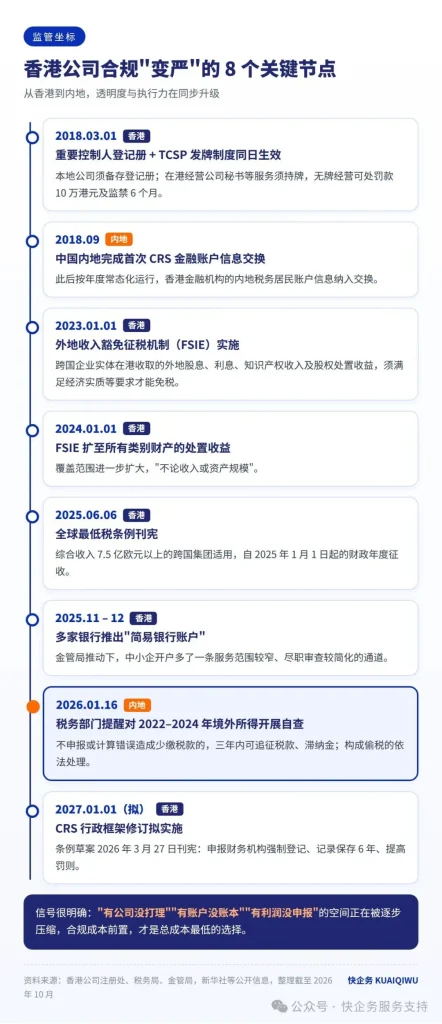
Placing the rule changes of recent years on a timeline reveals two lines tightening at the same time:
Locally in Hong Kong
: From the 2018 requirement for companies to keep a register of significant controllers and the licensing regime for company secretaries and other services, to the implementation of the foreign-sourced income exemption regime (FSIE) from 2023, and then to the rollout of the global minimum tax, it is becoming increasingly transparent ”who is behind the company, where it operates, and where its profits come from.”
On the mainland side
: Since 2018, mainland China has automatically exchanged financial account information with other tax jurisdictions (CRS, the Common Reporting Standard, which can be understood as tax authorities across countries sharing ”who opened accounts offshore and how much is in them”). In January 2026, Xinhua reported that tax authorities reminded taxpayers to conduct self-checks on overseas income for 2022–2024.
Of course, the rules are not only tightening. At the end of 2025, several Hong Kong banks, with the push from the HKMA, launched ”simple bank accounts,” offering SMEs a lighter-weight option for account opening. The higher the transparency, the easier it is for businesses operating in good faith to obtain convenience.
III. The First Hurdle: Bank Accounts — Opening Is Not Enough; You Must Keep Them
Why account opening is getting harder
Hong Kong banks must conduct customer due diligence under the Anti-Money Laundering and Counter-Terrorist Financing Ordinance (Cap. 615). For enterprises, banks care most about a few things: who controls the company, what business it does, where the money comes from and goes, and how large the expected transaction volume is. Startups often have no track record, contracts, or transaction history, so persuading a bank is naturally harder.
But some practices are unreasonable. In its "Guide on Account Opening and Maintenance," the HKMA states that banks should not make the purchase of wealth management products, insurance, or a large initial deposit a condition for account opening, nor should they refuse account opening based on an excessively high turnover threshold or require startups to provide operating records like those of mature companies. After a rejection, the bank should generally explain the reason, and the enterprise can also try another bank or report the matter to the HKMA.
Before opening an account, it is advisable to prepare three things: a business description that clearly explains ”what you sell, to whom, and how you collect payment”; materials that can prove the business is real, such as letters of intent, quotations, supplier information, or website/store pages; and an equity structure chart from the company to the ultimate beneficial owner. The more solid the preparation, the more quickly the bank can understand you during the interview.
Why accounts get closed even after opening
Banks periodically review existing customer information according to risk levels, which is why many enterprises are ”suddenly asked to supplement materials years after opening an account.” During reviews, the following four types of signals most easily attract attention:
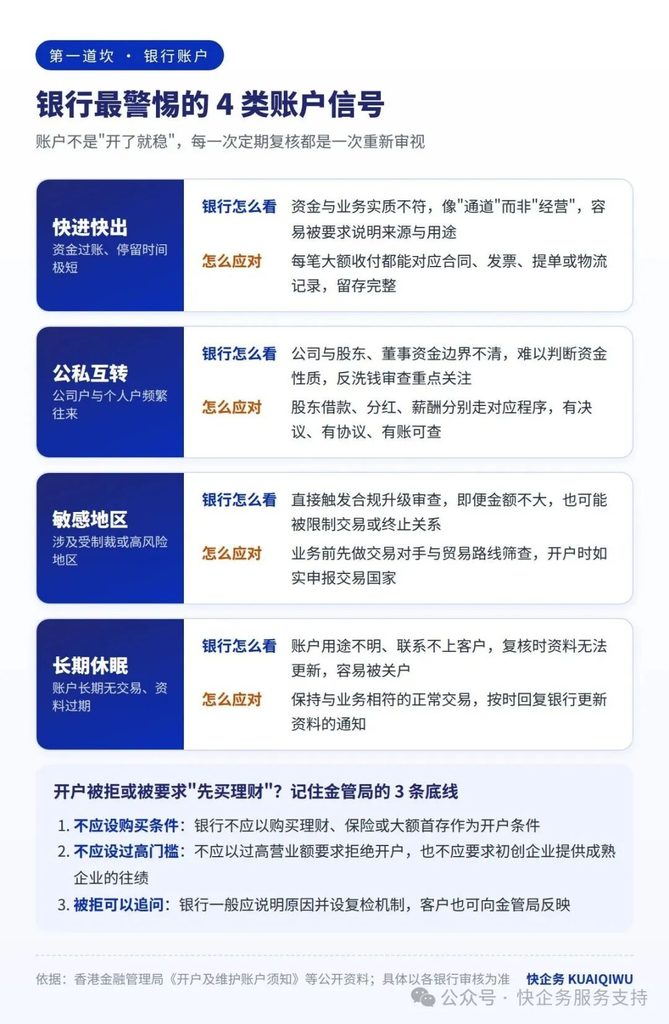
The core of the response comes down to one sentence: make sure every transaction has corresponding business documentation. Contracts, invoices, bills of lading, and logistics records should be archived as a matter of routine, and when the bank writes, reply on time and truthfully — far more effective than explaining after the fact.
IV. The Second Hurdle: Tax Audit — The Road for ”Zero Filing” Is Getting Narrower
Auditing is not optional
Many people assume that a Hong Kong company ”doesn't need bookkeeping if it hasn't made money.” In fact, the Companies Ordinance (Cap. 622) provides that, except for inactive companies, all companies' financial statements must be audited. The Inland Revenue Department also requires that when a corporation submits a profits tax return, it must attach audited financial statements and a tax computation; small corporations with total income not exceeding HK$2 million are no longer exempt from submitting these supporting documents.
In other words, as long as the company's account has transactions, it needs a set of books that can match those transactions. For failure to file taxes on time, the Inland Revenue Department may prosecute under the Inland Revenue Ordinance or assess additional tax, which can be up to three times the tax underpaid.
Take a common scenario: a Hong Kong company engaged in re-export trade ships goods from a mainland factory directly to an overseas customer, with payments received and made through a Hong Kong account. At year-end audit, the accountant needs to check purchase contracts, sales invoices, bills of lading, and bank statements one by one. If documents are casually discarded during the year and only replaced at year-end, audit fees and time costs will multiply.
Offshore exemption and FSIE are two different things
Many enterprises confuse the two sets of rules, so let's separate them here:
”Offshore claim” for trading and service profits”
: Hong Kong taxes on a territorial source basis and levies profits tax only on profits arising in or derived from Hong Kong (for corporations, the first HK$2 million of profits is taxed at 8.25%, and the remainder at 16.5%). To apply for offshore exemption, the Inland Revenue Department will determine case by case where the profits were actually generated, and the enterprise needs to produce evidence such as where contracts were signed, where negotiations took place, and where performance occurred.
FSIE (Foreign-sourced Income Exemption regime)
: This applies to foreign-sourced dividends, interest, intellectual property income, and disposal gains received in Hong Kong by ”multinational enterprise entities.” It took effect in 2023 and was expanded in scope from 2024, regardless of the amount of income or assets. To obtain exemption for such income, non-pure equity holding entities must meet economic substance requirements, that is, employ enough qualified employees in Hong Kong and incur enough operating expenditure; the Inland Revenue Department does not set a uniform minimum threshold and assesses on a case-by-case basis.
Shell companies with no employees, no office expenses, and no business records will find it hard to stand up under either set of rules.
V. The Third Hurdle: Statutory Company Secretary — The Cheapest Service May Be the Most Expensive

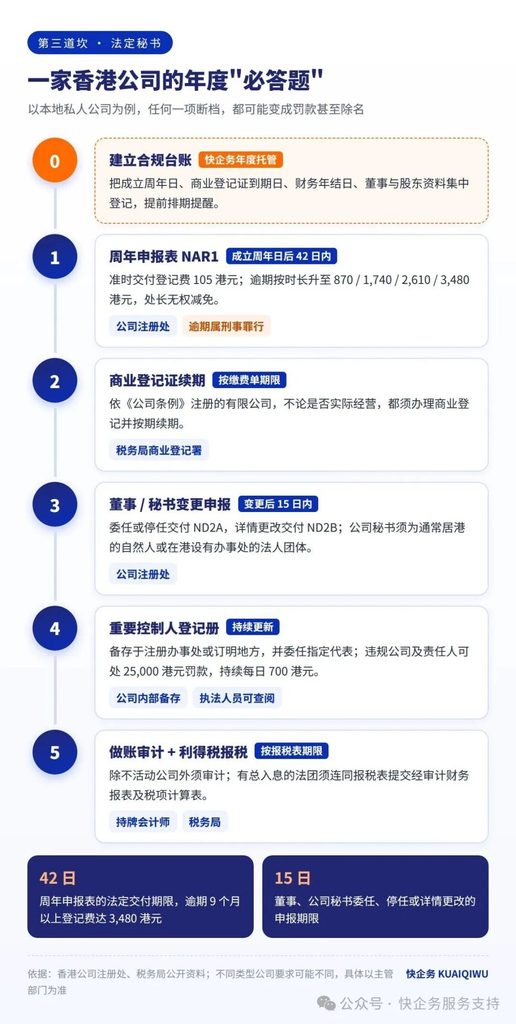
Hong Kong law requires every private company to appoint a company secretary: a natural person must ordinarily reside in Hong Kong, and a body corporate must have a registered office or place of business in Hong Kong. The value of the secretary lies in completing a series of statutory deadlines on time.
How strict are the deadlines? Take the annual return as an example: a local private company must deliver it within 42 days after the anniversary of its incorporation. On-time filing costs only HKD 105; if overdue by more than 9 months, the registration fee rises to HKD 3,480, and the Registrar of Companies has no power to waive it. Late delivery itself is a criminal offence, and the company and its responsible persons may be prosecuted.
The hidden costs of cheap secretarial services
Since March 2018, providing company secretarial, registered address and other services in Hong Kong requires a TCSP (Trust or Company Service Provider) licence from the Companies Registry. Operating without a licence is punishable by a fine of HKD 100,000 and imprisonment for 6 months. In reality, some low-cost intermediaries only provide ”nominee” arrangements and do not send reminders; once an intermediary disappears, company documents, registers and correspondence may all go missing.
A more serious consequence is deregistration: if the Registrar has reasonable cause to believe that a company is not carrying on business, it may strike the company off the register, upon which the company is dissolved and its property may vest in the Government as bona vacantia. Although restoration to the register can be applied for afterwards, it requires completing documents and paying fees, which is time-consuming and laborious.
When choosing a secretary, first check the licence, then check whether there is a proactive reminder mechanism and complete document handover.
If you indeed need to change secretarial companies, at handover at least confirm four things: who holds the original statutory records (the registers of directors, members, company secretaries and significant controllers); whether the annual returns, business registration certificates and audit reports for all years are complete; whether any change of registered office address has been reported; and whether the appointment of the new secretary is delivered for registration within 15 days.
VI. The Fourth Hurdle: Cross-Border Funds — Money Must ”Come Back” and, More Importantly, Be ”Clearly Explained”
The most common misconception: transferring company money directly to a personal card
Transferring money from a Hong Kong company account directly to the mainland personal account of a shareholder or friend or relative easily triggers attention in both places. Under the regulations of the People's Bank of China, where a natural person's account conducts a cross-border transfer equivalent to USD 10,000 or more in a single day, the bank must submit a large-value transaction report; if a sum of money is split among multiple people for separate settlement of foreign exchange, the State Administration of Foreign Exchange explicitly classifies this as splitting, and banks may refuse to process it and report it.
The tax dimension is also catching up. Resident individuals must pay individual income tax in accordance with the law on income obtained both domestically and abroad. Dividends distributed by a Hong Kong company to mainland individual shareholders fall under ”income from interest, dividends and bonuses” and are subject to a proportional tax rate of 20%. Xinhua News Agency reported in January 2026 that tax authorities may recover underpaid tax and late payment penalties within a three-year recovery period; according to public reports, in the first half of 2026, the regulation of tax administration for residents' overseas income cumulatively urged the payment of approximately RMB 34 billion in back taxes and late payment penalties.
If funds have already flowed back in a personal name in the past, or dividends have been received without declaration, rather than waiting for a reminder from the tax authorities, it is better to first sort things out yourself: which funds are loans, which are dividends, and which are collections and payments on behalf of others, and complete the supporting documents for each; where there is indeed taxable income, promptly make a supplementary declaration. Proactive correction is usually much less costly than passive response.
Two common paths for compliant repatriation
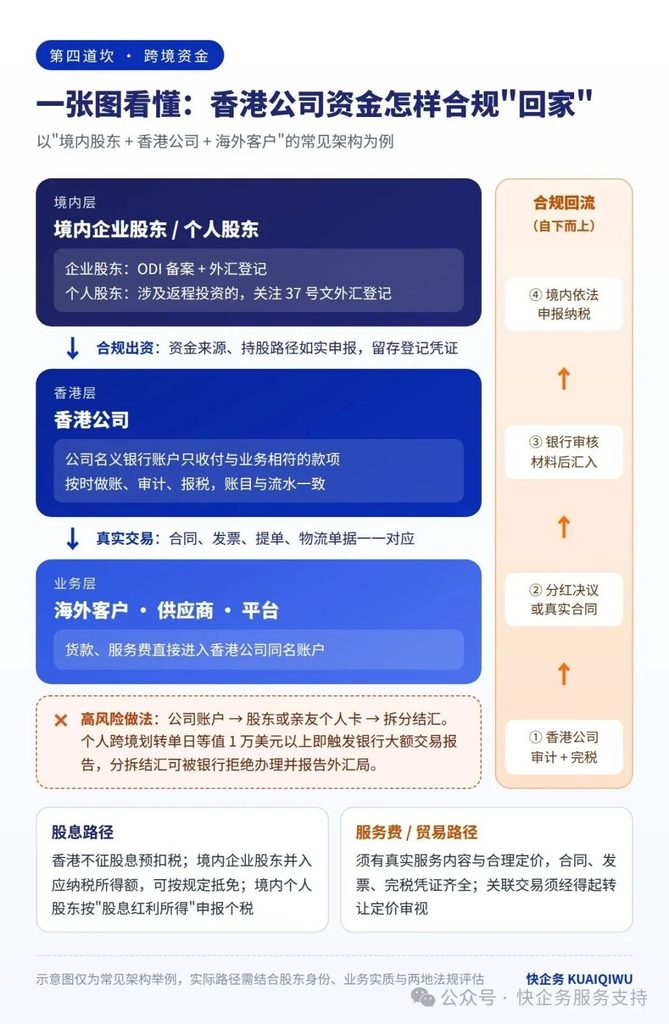
Dividend path
: Hong Kong company completes audit and tax payment → board of directors passes a dividend resolution → repatriation to the mainland. Hong Kong does not levy dividend withholding tax. Mainland enterprise shareholders include dividends in taxable income and may claim credit in accordance with the rules; for a Hong Kong company established with enterprise capital contribution, ODI (outbound direct investment) filing and foreign exchange registration should be completed at an early stage, so that repatriation has a ”pass.”
Service fee or trade path
: Based on genuine service content or goods transactions, with complete contracts, invoices and tax payment vouchers, and reasonable pricing. Charges between related companies must also withstand transfer pricing scrutiny.
Whichever path is taken, the key is to make the nature of the funds, the transaction vouchers and the declaration records consistent.
VII. Connecting the Four Hurdles into One Line
Viewed separately, the four hurdles belong to banks, accountants, secretarial companies and mainland tax and financial advisers; viewed together, they share the same underlying set of materials:
The shareholder, director and significant controller information maintained by the secretary is the basis for bank KYC review;
The audit report issued by the accountant is the basis for tax filing, offshore claims and dividend resolutions;
The dividend resolution and tax payment vouchers in turn determine whether funds can be repatriated to the mainland in compliance and how mainland shareholders should declare.
Therefore, the most worry-free approach is one set of materials, one calendar and one person in charge: put the anniversary date, business registration expiry date, year-end date, tax filing deadlines and bank review milestones into the same compliance calendar, and have a team familiar with the rules of both places follow up in a unified way, avoiding ”each managing only one segment without communicating with one another.”
VIII. What Kuaiqi Wu Can Do for You
Kuaiqi Wu is a corporate overseas business services provider with 16 years of business services experience, covering 125+ countries and regions, with a cumulative 100,000+ services completed. It has localised service teams in Shenzhen, Beijing, Shanghai, Guangzhou and Hong Kong, and provides 24-hour human response.
For the four hurdles of Hong Kong companies, we provide full-cycle support:
Statutory secretary and annual review custody
: Annual returns, business registration renewal, significant controllers register and director change filings, with advance scheduling reminders;
Bookkeeping, auditing and tax filing
: Liaising with Hong Kong licensed accountants, assisting with audits and profits tax filings, and organising the materials required for offshore claims;
Bank account opening and account maintenance
: Preparing account opening materials, assisting with responses to bank reviews, and organising transaction background documents;
Cross-border fund compliance
: ODI filing, foreign exchange registration, dividend repatriation path planning, and cooperation with lawful declarations in both places.
The service process is: compliance health check → customised plan → full-process handling → annual custody.
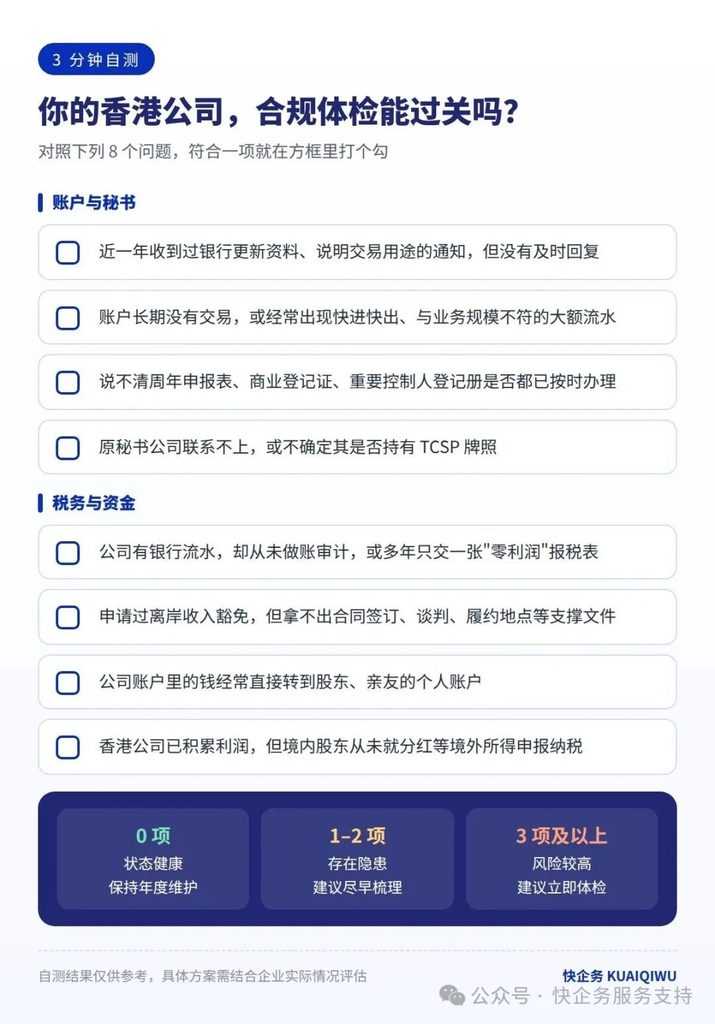
IX. 3-Minute Self-Test: Is Your Hong Kong Company Healthy?
If you tick 0 items, it means the fundamentals are solid and you only need to maintain annual upkeep; for 1–2 items, it is advisable to sort things out as early as possible; for 3 or more items, it is advisable to conduct a comprehensive compliance health check as soon as possible and first shore up the highest-risk areas.
Conclusion
Hong Kong companies remain an important platform for businesses going global. What has changed is not their value, but the standard for ”managing” them. Treat the four hurdles of banking, tax, secretarial services and funds as mandatory annual questions to be answered in advance, on time and consistently, and only then can a Hong Kong company truly become a boost to the business rather than a hidden risk.
Disclaimer: The content of this article is compiled from public information including the Hong Kong Companies Registry, the Inland Revenue Department, the Hong Kong Monetary Authority, the People's Bank of China, the State Administration of Foreign Exchange and Xinhua News Agency, with information current as of 12 October 2026. The case scenarios in the article are designed to illustrate the issues and do not refer to any real enterprise. This article is for general reference only and does not constitute legal, tax or investment advice; bank review requirements and regulatory provisions may change, so please refer to the latest requirements of the competent authorities and financial institutions, and consult professionals in light of your own circumstances.